Published on Oct. 5, 2026
Redefining Sow Performance Through Management, Data, and Balanced Genetics
Sow productivity has progressed considerably over the past two decades. Today’s sows are more prolific and capable of producing more piglets than previous generations. Yet this progress has also brought new challenges. Sow mortality, premature removal, and limited longevity continue to affect animal welfare, farm efficiency, and profitability.
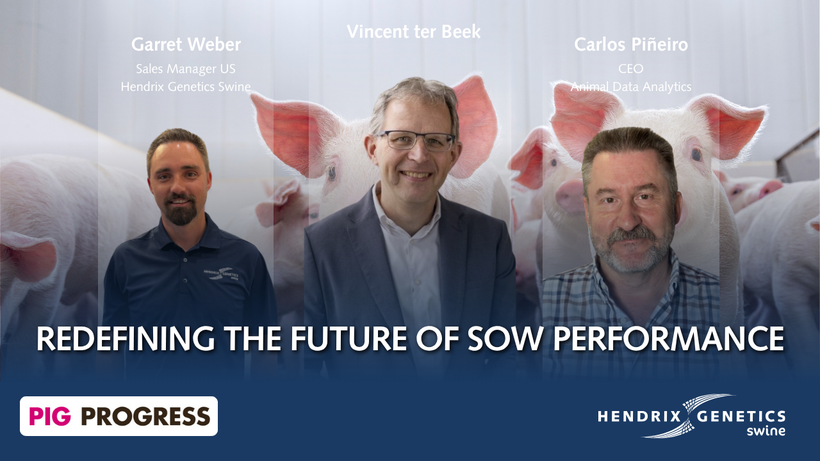
On September 10, 2026, Hendrix Genetics Swine partnered with Pig Progress to host a webinar on one of the swine industry’s most pressing challenges: improving sow longevity and survivability while maintaining strong productivity.
The one-hour session featured Carlos Piñeiro, CEO of Animal Data Analytics, and Garret Weber, U.S. Sales Manager at Hendrix Genetics Swine. Together, they shared their insights on the physiological, management, and genetic factors influencing sow performance.
More Productive Sows Face Greater Physiological Demands
Over the past two decades, genetic improvement has fundamentally reshaped the modern sow. Selection for prolificacy, maternal performance, and piglet survival has produced females capable of delivering larger litters and greater quantities of milk than ever before. While these advances have significantly improved production efficiency, they have also increased the biological demands placed on the sow throughout gestation, farrowing, and lactation.
During the webinar, Carlos Piñeiro emphasized that modern sows operate within a much narrower physiological margin than their predecessors. Increased litter size, accelerated fetal growth, and higher lactational output require substantial nutrient, energy and metabolic resources. This helps explain what Piñeiro described as a paradox of modern pig production. Despite unprecedented gains in reproductive output, sow mortality and premature removal remain important challenges in many production systems. Genetic progress has increased the sow's biological potential, but production systems have not always advanced at the same pace to consistently support the potential.
From this perspective, sow mortality should not be viewed as the result of a single event or disease, but as the endpoint of physiological pressures that accumulate over time. The industry’s challenge, therefore, is not to reduce productivity, but to better align genetic potential with management practices that support long-term health, resilience, and lifetime performance.
Understanding the Cumulative Impact of Stress
Sow mortality is rarely attributable by a single factor. Immediate causes such as prolapse, lameness, reproductive disorders, or sudden death may be recorded, but these events are often final consequence of several overlapping challenges. Heat, disease, social pressure, inadequate nutrition, poor body condition, housing conditions, and the metabolic demands of reproduction can accumulate over a sow’s lifetime.
To explain this phenomenon, Carlos Piñeiro introduced the concept of allostatic load. This refers to the cumulative wear placed on an animal caused by repeated exposure to physiological and environmental stressors. As these pressures build, the sow’s functional reserve gradually declines. Early signs can be difficult to detect often appearing as reduced performance or mild clinical symptoms. If the challenges persist, they can lead to severe health problems, premature removal, or mortality. This highlights the importance of looking beyond the final recorded cause of death. Producers must consider the entire system surrounding their sows and identify the combination of factors that may be compromising resilience.
Critical Periods Require Greater Attention
The period surrounding farrowing is one of the most demanding stages of the reproductive cycle. Information presented during the webinar showed that mortality can rise considerable around farrowing before declining after weaning. Several stressors may occur simultaneously during this period. Farrowing itself places significant physiological pressure on the sow, while heat, disease, and nutritional challenges can further reduce her ability to cope.
Lactation presents another major metabolic challenge. Supporting a productive litter requires considerable milk output at a time when the sow may be unable to consume enough feed to fully meet the nutritional needs. This is particularly important for gilts, which have a lower feed intake capacity and are still growing. Inadequate support during this period can compromise body condition, future reproductive performance, longevity, and lifetime productivity. However, optimal gilt development can be hindered by incomplete data and a lack of individual monitoring. To bridge this gap, precision feeding and monitoring technologies can help producers better understand individual growth, feed intake, and development, allowing management to be adapted more closely to the needs of each animal.
As Carlos Piñeiro explained, investing in gilt care is more than an additional management objective - it is an investment in longevity and lifetime performance.
Better Decisions Begin with Better Data
A recurring industry challenge is the quality and consistency of sow data, which can make comparisons difficult and obscure recurring patterns. Standardized terminology and clearer distinctions between primary and contributing causes could make mortality and removal records more meaningful. When feasible, necropsies and diagnostic confirmation can provide additional insight. The goal is not to record every detail, but to consistently capture the most relevant information and connect data from multiple sources to support better decision-making.
Genetics is One Part of a Complete System
Genetics provide the biological foundation for lifetime sow performance. Through cumulative selection across generations, breeding programs shape a range of interconnected traits including prolificacy, maternal capacity, structural soundness, feed efficiency, disease resilience, behavioral characteristics and longevity. Genetic improvement does not only influence how many piglets a sow produces, but also her ability to cope with the physiological demands of modern pig production systems.
During the webinar, Garret Weber emphazied that the industry's challenge is no longer solely to increase production potential. Modern breeding objectives increasingly seek to balance productivity with robustness and retention. This shift reflects a growing recognition that lifetime performance is determined not only by reproductive output per parity, but by a sow's capacity to remain healthy, functional and productive across multiple reproductive cycles.
The webinar audience reinforced this perspective with more than 90% of participants indicated that they believe genetics plays a role in sow mortality. These responses suggest that producers increasingly view genetic selection as a strategic tool for addressing challenges such as sow mortality, replacement rate, labor efficiency and overall system profitability. As Garret Weber emphasized, genetic progress is an ongoing process. Future breeding strategies must continue to integrate traits associated with survivability, structural integrity, maternal performance and resilience while maintaining competitive levels of productivity. Rather than pursuing prolificacy as an isolated objective, the emphasis is increasingly on developing females capable of delivering consistent lifetime performance across a wide range of commercial production conditions.
The Search for a More Balanced Sow, Nexus 100
Nexus 100 is Hendrix Genetics Swine’s response to the industry’s need for a more balanced sow. This F1 sow combines the complementary breeding approaches of Hypor and Danish Genetics, bringing together robustness, longevity, maternal performance and structural soundness with prolificacy, reproductive efficiency and pig output. Developed to support performance across the entire production system, Nexus 100 emphasizes predictability, stability and consistent results to promote both sow survivability and lifetime productivity.
Early results presented during the webinar included 18 total born piglets, 16.5 born alive and the potential to wean more than 15 piglets per litter. Results from early parities in France also showed sow survivability above 95%. The broader ambition is to create a sow capable of delivering high pig output and long-term value across diverse production environments.
The Work is Never Finished
The swine industry has every reason to be proud of the progress achieved in productivity. However, sow mortality remains a global challenge, and further improvement is still required. For Hendrix Genetics Swine, the development of Nexus 100 reflects a commitment to continuous progress.
We are going to continue to be a genetic supplier that never stops, that continues to improve every day
The future of sow performance will not be defined by prolificacy alone. It will depend on the industry’s ability to produce robust, manageable, and productive sows that remain in the herd longer and deliver consistent value throughout their productive lives.