Published on May 27, 2026
Piglet Survivability Before Record Litters: A Responsible Path for Modern Pig Breeding
The current debate on extreme selection in pig production calls for nuance and evidence. Legislation exists in this area, but equally important are long-established breeding strategies that have pursued a clear and responsible objective for years: more piglets that survive and thrive, not simply higher totals on paper.
At Hendrix Genetics Swine, breeding objectives have consistently focused on robustness and survival for almost ten years. This is a deliberate, long-term choice that differs fundamentally from a one-sided pursuit of ever larger litters.
Documented Higher Survival, Year After Year
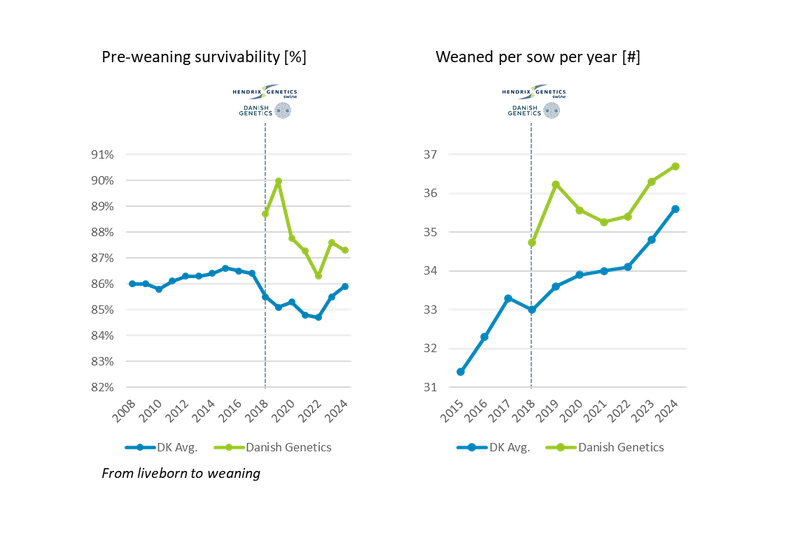
For at least the past seven years, herds have delivered: higher sow survival, higher piglet survival and greater production stability in practice, compared with Danish averages and competing breeding systems. These results are not coincidental. They reflect a long-term breeding strategy where traits related to survival, strength and maternal ability have been given high priority, well before robustness became a political or societal buzzword.
Breeding Goals Focused on Balance
Our breeding goals are clear, transparent and balanced. For maternal lines, a significant share of genetic progress is dedicated to piglet loss and survival, number of stillborn piglets, uniformity in birth weight, teat number and maternal capacity and sow strength and longevity.
For sire lines and finishing performance, efficiency plays an important role, but it is always underpinned by robustness and functionality.
The key point is this: the objective is not to push litter sizes higher. The objective is to close the gap between total born and weaned piglets by increasing the number of piglets that survive until weaning. Additional piglets only create value if they survive and if the sow can nurse them without increased strain, mortality, or the need for compensatory management practices.
Robustness Is Not the Opposite of Efficiency
Public debate often presents efficiency and animal welfare as opposing forces. Experience shows the opposite. When sows live longer, piglets are more vital and variation within litters is reduced, production becomes more predictable, more resource efficient and less demanding for both animals and people.
This is precisely why robustness forms the foundation of the breeding program today, as the result of nearly a decade of focused and deliberate work.
A Constructive Way Forward for the Sector
If pig production is to retain both legitimacy and competitiveness, it requires strategies that perform in real-world conditions, not just in statistics. Breeding approaches that prioritise survival over records, balance over extremes, and long-term sustainability over short-term output are part of the solution.
At Hendrix Genetics Swine, the commitment remains to document, develop and deliver genetics where robust sows and viable piglets form the foundation of animal welfare, supporting total efficiency across economy and carbon footprint, without compromising animal welfare.