Published on April 7, 2026
Weaning Your Way to Success with Hendrix Genetics Swine
In the pork business, quantity without quality fails to satisfy expectations. Traditionally, sow productivity has been defined as the number of weaned pigs per sow per year. However, piglet quality is also essential to give them the best chance at reaching market weight in fewer days.
The profitability of pork producers is driven by the amount of pork sold per sow in the herd. This de facto makes weaning capacity a critical element for success. This change in perspective is a result of huge improvements in total born piglets over the last two decades.
Indeed, since the implementation of BLUP [Best Linear Unbiased Prediction], total born has progressed at a rate of ~0.60 piglets born/sow/year. Unfortunately, such tremendous improvement carries with it negative consequences: impact on piglet quality, survival and performance later in life. In this context, Hendrix Genetics Swine recognizes that weaning traits (like weaning age of pigs or piglet survival rate) have gained importance to counterbalance the downside of this strong improvement in total born.
Optimizing Total Born Without Compromising Piglet Viability
For several years, our brand Hypor has defined additional essential traits within its reproduction package. The number of total born piglets is often negatively correlated with other important characteristics, such as piglet birth weight and variation in piglet size. In other words, when one trait improves, another may decline.
That's why it is important to focus on complementary traits to ensure our piglets are of the highest possible quality and get a strong start in life. By not solely prioritizing total born, but also considering the number of born-alive piglets and the percentage of weaned pigs, we promote heavier, high-quality, and more uniform animals at birth.
Those heavier weights are vital for giving piglets a fast start. In our nucleus units, which house the purebred parents of the Hypor Libra (Hypor Landrace and Hypor Large White), individual birth weights are taken on every piglet born. This method is far more precise than weighing the entire litter and calculating an average.
Hypor’s geneticists can then incorporate additional data, such as the range of birth weights within a litter, and select for lower variation or more uniform litters. They also record the number of piglets weighing less than 800g (1.76 lb) at birth. This allows them to monitor (and reduce) the number of small piglets born. Improving both of these traits leads to heavier and more uniform litters in the purebred populations, which are inherited by the Hypor Libra.
Weak and lightweight piglets are more likely to die before weaning. Therefore, a good start at birth plays a major role in helping them survive and thrive. With this in mind, Hypor’s piglet quality package assigns extra points to heavier piglets at birth and penalizes litters with piglets born under 800g (1.76 lb). It also favors uniform litters, as consistency in birth weight contributes to improved piglet survival rates.
Milk-Driven Growth: The First 14 Days
To achieve an optimal number of piglets at weaning and ensure they reach a heavy weight, the sow must be capable of raising them successfully. That is why, in Hypor nucleus units, we do not give piglets any supplemental feed. They rely exclusively on the sow's milk from farrowing until day 14. Consequently, piglet weight and growth during that period are directly linked to milk production and the quality of the sows.
By measuring individual piglet weights at 14 days of age, it becomes possible to assess an individual sow’s ability to produce abundant, high-quality milk for her litter. This is precisely why the Hypor Libra produces piglets that excel throughout their lives, thanks to strong maternal traits and optimal piglet nutrition.
Teat Number and Quality in Hypor Dam Lines
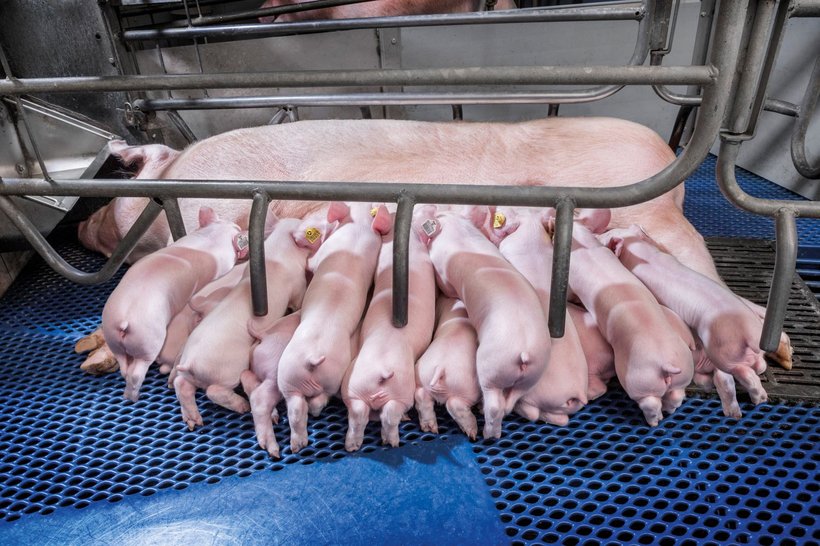
When selecting Hypor Landrace and Hypor Large White replacement animals, Hendrix Genetics Swine adheres to strict standards for both teat number and teat quality. At a minimum, dam line boars must have 15 teats, while dam line gilts must have 14 teats.
"At our unit, we aim for 16 or more teats. It's common to see sows weaning 17 or 18 piglets thanks to their higher teat count," says Janet Englot, manager at Tullymet. "Just a few years ago, weaning 14 piglets was considered exceptional. Now, we're consistently at 16 teats and strive for even better results. That’s why the number of functional teats is a critical trait in our dam lines."
To further improve weaning capacity, sows at the nucleus level are constantly challenged to nurse as many piglets as their functional teats can support. This approach ensures the selection of top-performing sows. These sows, in turn, produce high-quality replacement gilts that help meet the evolving needs of pork producers.
In addition, our quality control staff evaluates several other traits that contribute to the success of both sows and piglets. These include teat length and shape, as well as uniform spacing between teats along the underline. Boars and gilts are only selected if they receive the quality control seal of approval.
Quality from the Start: The Hypor Standard
Quality is a consistent focus at the Hypor nucleus units. Our teams work to select the best grandparents with exceptional weaning capacity to pass on to the Hypor Libra.
"Right from the start, we look for sows that can farrow independently, without assistance," says Englot. "We also prioritize sows that are quiet, calm, and good mothers. The goal is for them to carry the litter through and wean at least 16 healthy piglets with minimal intervention."
To make this possible, the staff at Tullymet does everything they can to set the sow up for success. They ensure she is healthy, well-hydrated, and properly fed—especially during the demanding lactation period. The sow can then consistently wean large, vigorous litters without compromising her body condition or future reproductive performance. This attention to piglet nutrition and maternal care is essential for long-term productivity.
Total System Profitability: Where Genetics Meet Economics
Maximizing weaning performance involves a range of factors, but ultimately comes down to a simple formula: "Quality + Quantity = Profit."
“When you have a sow that performs well in the farrowing room, weans 16 to 18 piglets, and returns to service in under five days, success is inevitable,” says Englot.
Profitability remains a central pillar of the Hypor Libra’s appeal across multiple dimensions. In Spain, for example, antibiotic usage in swine production remains relatively high. Producers must therefore seek effective strategies to reduce their use.
Enhancing piglet birth weight and overall quality, combined with the Hypor Libra’s exceptional milking ability, helps minimize the need for cross-fostering and supplemental care. This, in turn, reduces labor demands, antibiotic use, production costs, and environmental impact.
Most importantly, the Hypor Libra delivers exceptional performance from wean to finish, and so do her piglets, driving progress and delivering value at every stage of production.
Improved uniformity from the outset translates into greater consistency at weaning and finishing. As a result, pigs reach market weight more quickly, saving both time and money. With Hendrix Genetics Swine’s commitment to continuous improvement, the strengths of the Hypor Libra will only grow. And given her current performance, any future enhancements will simply be added value.