Published on May 26, 2026
Hendrix Genetics Swine Breeding Goals Turn Survival Into Real Efficiency
At Hendrix Genetics Swine, breeding efficiency is defined by outcomes that perform reliably on farm. Across our global portfolio, we focus on balanced genetic progress that delivers robust animals, predictable performance and long term sustainability for pig producers.
Within this approach, Danish Genetics, a Hendrix Genetics Swine brand, plays a leading role by translating survival, robustness and feed efficiency into measurable economic results.
While record litter sizes often dominate public attention, production reality tells a different story. Survival, robustness and efficient resource use are what ultimately define success.
This is exactly the logic behind the current breeding goals of Danish Genetics breeds, a central part of the Hendrix Genetics Swine portfolio. It is also the logic underpinning the growing emphasis on piglet survivability rather than record litter sizes.
Breeding goals built on balance, not extremes
Hendrix Genetics Swine breeding goals reflect a deliberate shift away from one‑dimensional selection. Instead of chasing single records, the focus is on balanced genetic progress that performs under real herd conditions.
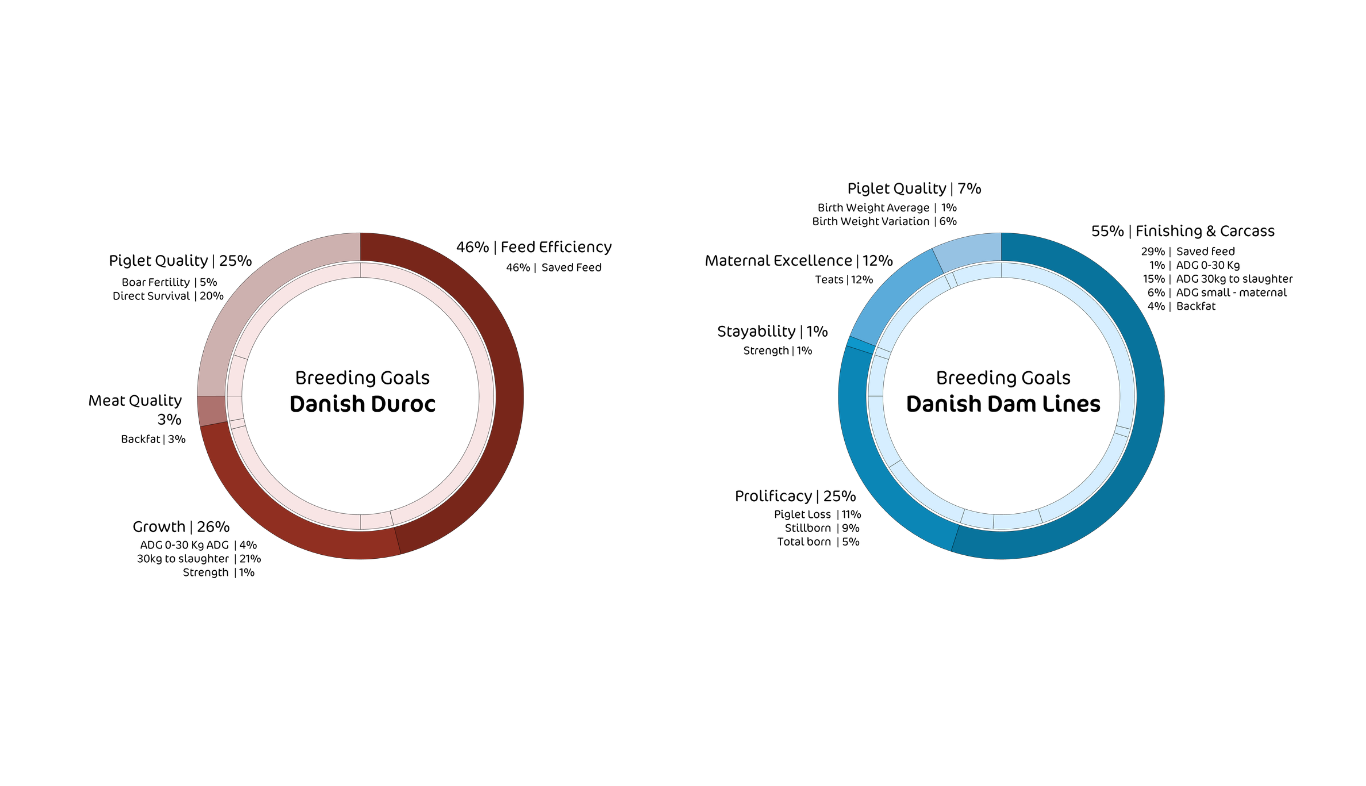
This is clearly illustrated in the Danish Duroc breeding goal, where 46% of total genetic emphasis is placed on feed efficiency, expressed as saved feed. Feed efficiency is the largest cost driver in pig production and one of the most powerful tools for reducing environmental footprint per kilogram of pork.
Importantly, this focus does not stand alone. It is supported by 26% emphasis on growth and 25% on piglet quality, with direct survival accounting for 20% of the total goal. The message is clear: feed efficiency only creates value when pigs survive, grow predictably and remain robust throughout the entire production cycle.
Piglet survival is part of the genetics not an afterthought
A recurring theme in public debate is that more piglets only matter if more piglets survive. In Danish Genetics dam lines, this principle is embedded directly into the breeding goal.
Prolificacy represents 25% of the total breeding emphasis, but the internal weighting tells the real story:
- Piglet loss: 11%
- Stillborn piglets: 9%
- Total born: 5%
Reducing losses is clearly prioritised over simply increasing numbers born. Genetic progress is aimed at closing the gap between total born and weaned piglets, not widening it.
At the same time, piglet quality (7%) focuses on birth weight level and uniformity. Uniform piglets are more viable at birth, compete less at the udder and require less corrective management, supporting higher survival without increasing welfare pressure on the sow.
Robust sows as the foundation of sustainable production
Piglet survival cannot be improved without robust, functional sows. For this reason, Hendrix Genetics Swine breeding goals place strong emphasis on maternal capacity and longevity.
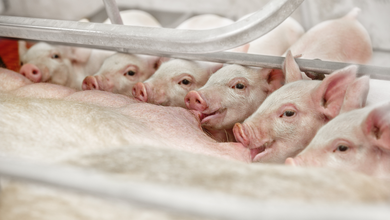
Maternal excellence (12%), driven entirely by teat number, reflects a fundamental biological reality: piglets cannot survive without sufficient nursing capacity and access to colostrum within the first 24 hours after birth is critical for their vitality and early survival. Genetic progress in teat number is one of the most effective and welfare‑friendly ways to support survival.
Combined with structural strength and stayability, this results in sows that live longer and deliver:
- Lower mortality
- Fewer replacements
- More stable production
- Reduced labour pressure
These outcomes reinforce a key point often overlooked in the debate: robustness is not the opposite of efficiency, it is a direct driver of profitability through lower costs per weaned piglet and higher margins per sow.
Efficiency that holds all the way to slaughter
In the Danish Genetics dam lines, 55% of the breeding goal is dedicated to finishing and carcass performance, with 29% directly linked to saved feed. Growth is optimised across production phases while maintaining control of backfat and functionality.
The result is pigs that convert feed efficiently because they are uniform and structurally sound, not because they are pushed to biological extremes.
From debate to practice
Where public discussion often focuses on what should change, Danish Genetics breeding goals demonstrate what already has changed:
- Survival over litter records
- Balance over extremes
- Robustness as a driver of efficiency
- Long‑term sustainability over short‑term output
The future of Danish pig production will not be defined by record numbers on paper, but by results in practice. Those results begin with breeding goals that put survival, robustness and efficiency at the centre.